Pages

Showing posts with label Cinema. Show all posts

Week 11.2.-12.1: His Girl Friday


His Girl Friday has a running time of 92 minutes. We will screen as much of the film as we can today, but finish our screening during our next session. Although we will not have finished the film, you should still have your study questions complete and ready to turn in for next time.

Study Questions:
1. What are the signs of modernity in His Girl Friday? How does all that is solid melt into air in the film?


2. What characters seem to handle the modern condition better? Which characters seem pre-modern?  How is this related to geography? What characteristics march each of these types?

3. What are we to make of the speed in which so many of the characters speak? What are the film's ideas about communication?

4. Is Hildy Johnson a "little man" like the Tramp or Kafka's protagonist? What similarities does she share with them? How is she different?

5. "Production for use" is an old socialist slogan. It is thought of the opposite of production for profit, the hallmark of the capitalist system.  What is the film's point of view on this particular ideology? Is it a capitalist film?

Weeks 14.2-15.1: Dr. Strangelove, or: How I Learned to Stop Worrying and Love the Bomb


Today in class we will be watching Dr. Strangelove, or: How I Learned to Stop Worrying and Love the Bomb (1964), a comedy about nuclear war. Please bring in the following questions to class. We will finish our discussion on 15.1. Be prepared to speak about the film on that day.

Study Questions:
 1. The character names in Dr. Strangelove are notable for their absurdity: General Ripper, Major "King" Kong, General "Buck" Turgidson, Dr. Strangelove, and Col. "Bat" Guano. Obviously these names are funny, but what more do they signify? Explain at least two of these names in relation to the character's actions and the themes of the film.

2. "Shoot, a fella’ could have a pretty good weekend in Vegas with all that stuff.” Paging Dr. Freud! Dr. Strangelove is a film obsessed with sex. Everything from the plane's phallic mid-air refueling to the survival kit contents, from Buck Turgidson's habitual gum chewing to Dr. Strangelove's repopulation plan has a sexual subtext or the sexual content is just plain text. What is the connection between sex and nuclear war in the film?

3.  In All that Melts into Air, Marshall Berman writes, "To be modern is to find ourselves in an environment that promises us adventure, power, joy, growth, transformation of ourselves and the world--and, at the same time, threatens to destroy everything we have, everything we know, everything we are" (15). How is nuclear war modern?

4. How might we describe the chain of command in Weberian or Kafkaesque terms? How does it compare to the description of organizations in Night and Fog?

5. Take on the perspective of Gandhi. Use Dr. Strangelove as a means to critique Western civilization. 

Week 9.1: Charlie Chaplin, Modern Times

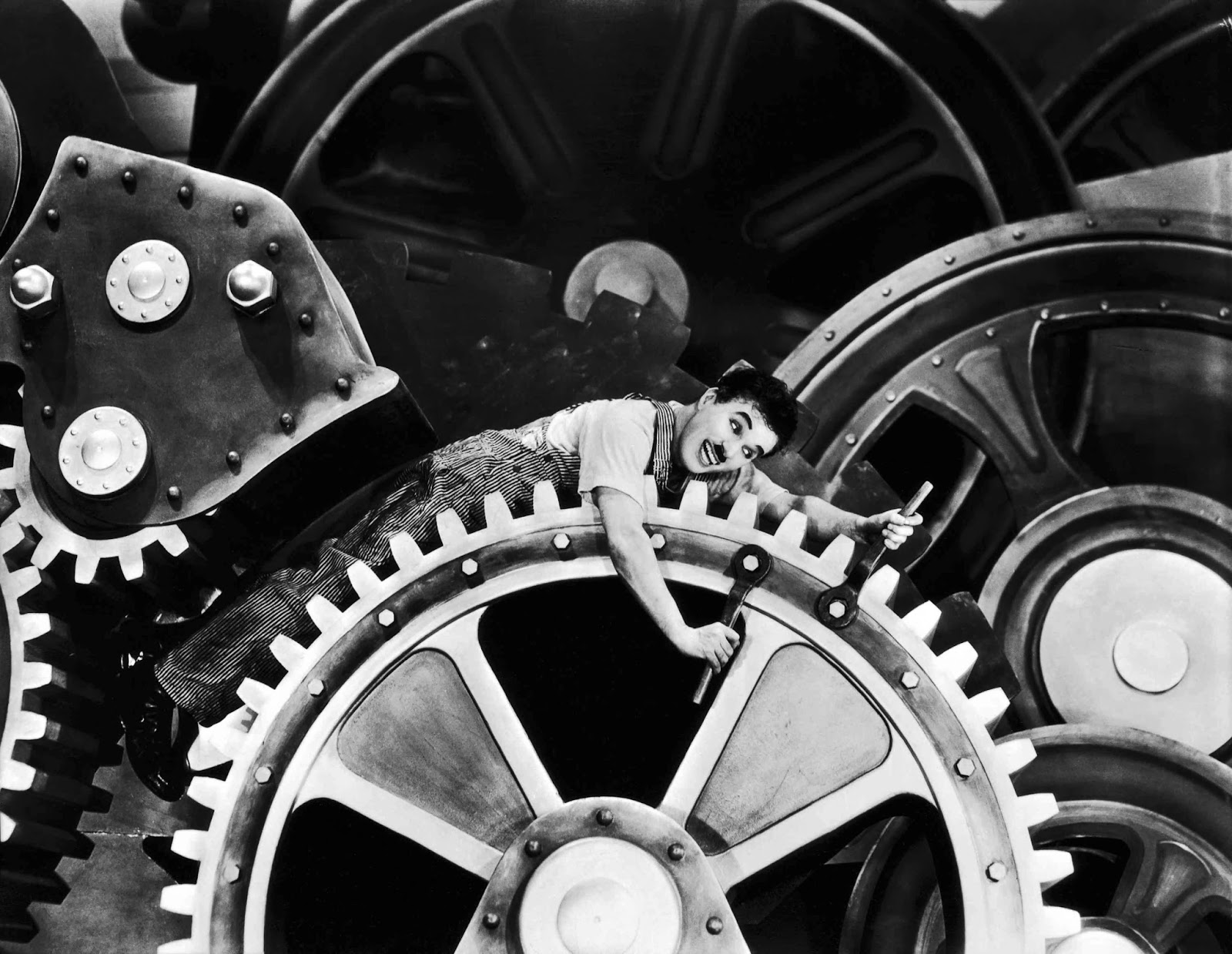
This week we will be watching Charlie Chaplin's Modern Times (1936). Just as we spoke earlier about actively reading literature, we also need to think about watching actively as well. Film is a text and it demands to be interpreted critically just as any novel does. As we watch Modern Times, I want you to answer the following questions. You will read these questions before attending our screening and you will print these questions out and take notes as we watch the movie. You will turn in the study questions the day we conclude our discussion. 

Note: Our class is 80 minutes long. Modern Times is 86 minutes long. I will start class three minutes early and end it three minutes late so that we can watch the complete film in one sitting.

Study Questions:
1.  Modern Times is a primarily silent film in the era of the talkie. What role does sound play in the film? Who speaks and when? How does the Tramp speak?

2. The film opens with a static image of a clock. Why might the film begin in this way?

3. Similarly, the film opens with these lines, "'Modern Times.' A story of industry, of individual enterprise -- humanity crusading in pursuit of happiness." What famous phrase does this intertitle recall? What point might Chaplin be making with this allusion?

4. Modern Times is in many ways about power. What sort of power is wielded by the film's antagonists? What type of power does the Gamin and the Tramp possess?

5. Compare and contrast the difference between the city and the country in the film. Why does Chaplin depict them in this manner?

6. Why does the film end where it does? What might be implied by the ending?